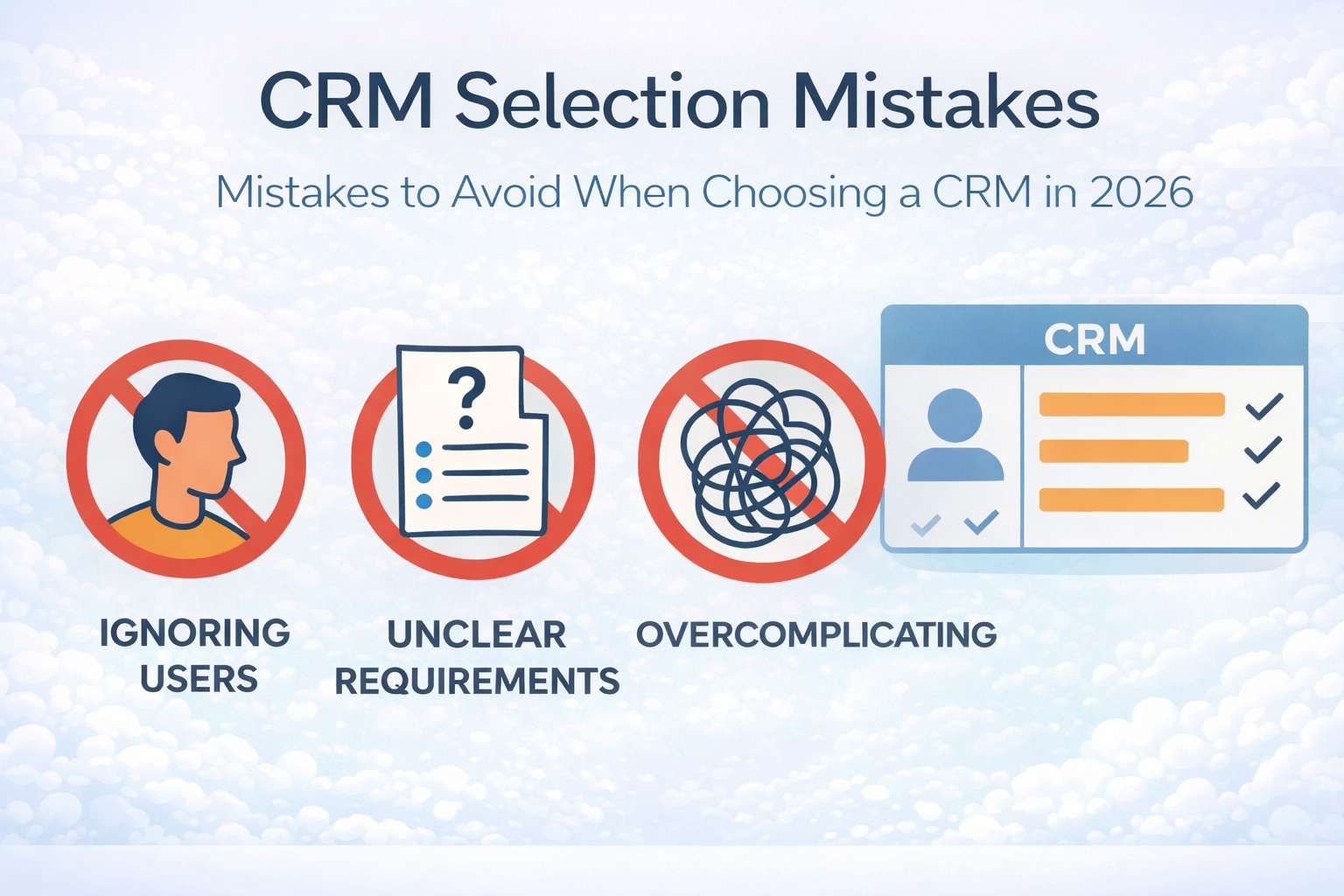
Avoid costly CRM Selection Mistakes with this 2026 guide. Learn how to choose the right CRM, improve adoption, and ensure successful implementation for long-term business growth.
Table of Contents
Choosing a CRM is one of the most important technology decisions a business can make. The right system can strengthen sales performance, improve customer relationships, and streamline operations. However, many organizations fall into common CRM Selection Mistakes that result in low adoption, wasted investment, and inefficient workflows.
This 2026 guide outlines the most frequent pitfalls businesses encounter when selecting a CRM and explains how to avoid them to ensure a smooth rollout and long-term success.
Why Choosing the Right CRM Matters
A poorly chosen CRM can create confusion, reduce productivity, and fail to support business goals. On the other hand, avoiding major CRM Selection Mistakes ensures the platform aligns with your processes, enhances collaboration, and delivers measurable ROI.
When the selection process is handled carefully, CRM becomes a growth engine rather than just another tool.
Top CRM Selection Mistakes to Avoid
1. Not Defining Clear Objectives
One of the biggest CRM Selection Mistakes is starting without clearly defined goals. Businesses must identify what they want to achieve—whether it’s improving pipeline visibility, automating marketing, or enhancing reporting.
Set measurable objectives before evaluating vendors.
2. Ignoring Feedback from End Users
Selecting a CRM without consulting the teams who will use it daily often leads to resistance and poor adoption. Sales, marketing, support, and IT teams should be involved early to ensure the system meets real operational needs.
3. Underestimating Data Migration Challenges
Data migration is more complex than many expect. Failing to plan for data cleaning, mapping, and validation can cause delays and data inconsistencies—another common CRM Selection Mistake.
4. Choosing an Overly Complex System
Many companies assume more features mean better results. In reality, overly complicated CRMs overwhelm users and slow adoption. Start with a system that meets current needs and can scale gradually.
5. Neglecting Training and Change Management
Even the best CRM fails if teams don’t know how to use it. A lack of structured onboarding and training is a frequent contributor to CRM project failure.
Investing in education helps avoid long-term CRM Selection Mistakes.
6. Overlooking Integration Requirements
CRMs must connect seamlessly with email platforms, marketing tools, accounting systems, and other business applications. Ignoring integrations leads to data silos and inefficient processes
7. Failing to Plan for Scalability
Businesses often select tools that work today but cannot support future growth. A scalable solution ensures your CRM evolves alongside your organization.
8. Lack of Ownership and Accountability
Without a dedicated owner or project team, CRM initiatives lose direction. Assigning responsibility ensures consistent optimization and accountability
Key Criteria for Evaluating CRM Platforms
| Criteria | Why It Matters | Questions to Ask |
|---|---|---|
| Usability | Drives adoption and productivity | Is the interface intuitive for daily users? |
| Customization | Aligns CRM with your workflows | Can we tailor fields and processes? |
| Integration | Enables smooth data sharing | Does it connect with existing tools? |
| Scalability | Supports future growth | Can it handle more users and data later? |
| Support & Training | Ensures successful onboarding | What training and support are offered? |
| Cost | Impacts ROI and budgeting | What are the total long-term costs? |
Evaluating these factors helps businesses avoid costly CRM Selection Mistakes during procurement.
Best Practices for a Successful CRM Selection
To make the right decision:
- Define success metrics tied to real business outcomes.
- Involve cross-functional teams for early buy-in and feedback.
- Request demos and trial periods to test usability in real scenarios.
- Review vendor roadmaps, support quality, and product updates.
- Plan integration and data migration strategies from the beginning.
Following these steps reduces risk and prevents avoidable CRM Selection Mistakes.
Frequently Asked Questions (FAQs)
What are the most common CRM selection mistakes?
Lack of planning, ignoring user needs, and unclear goals are among the biggest issues.
How can I ensure employees adopt the CRM?
Include users in the selection process, provide hands-on training, and keep workflows simple.
What integrations should a CRM support?
Email systems, marketing automation platforms, accounting tools, and customer service applications are essential.
Should businesses choose a simple or feature-rich CRM?
Start with a streamlined system and expand capabilities as processes mature.
Conclusion
Selecting a CRM is a strategic investment that requires careful evaluation, planning, and collaboration. Avoiding common CRM Selection Mistakes—such as unclear goals, poor training, or ignoring scalability—can mean the difference between a failed rollout and a highly effective business platform.
By focusing on usability, integration, and long-term growth, organizations can choose a CRM that supports productivity, strengthens customer relationships, and delivers sustainable value in 2026 and beyond.
