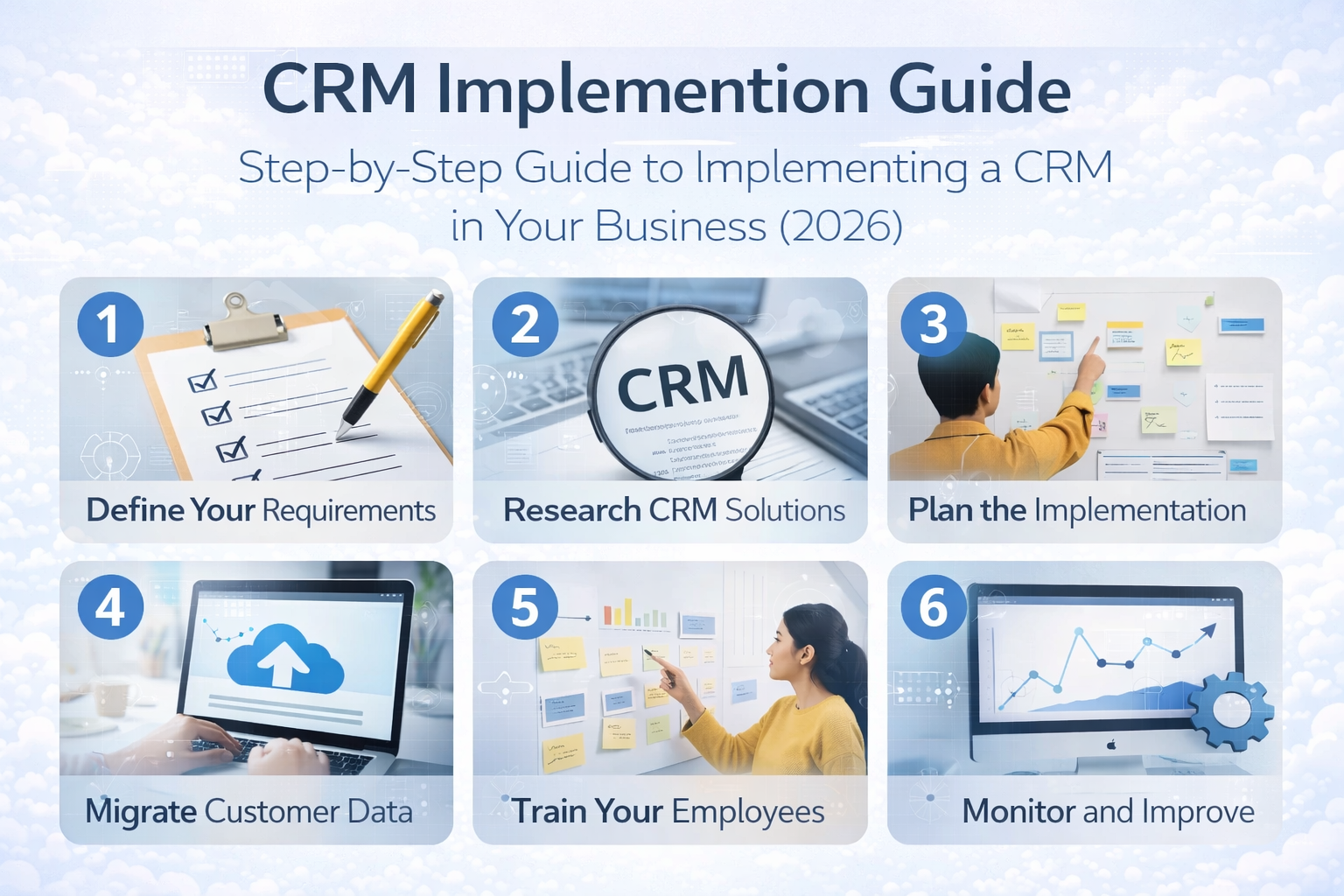
Follow this CRM Implementation Guide to successfully plan, deploy, and optimize your CRM in 2026. Learn key steps, best practices, and tools for a smooth rollout.
Table of Contents
Implementing a Customer Relationship Management (CRM) system can significantly improve how your business manages sales, customer interactions, and internal workflows. A structured CRM Implementation Guide helps organizations move from planning to execution while avoiding common issues such as poor adoption, messy data, or wasted investment.
This 2026 guide walks through every stage of CRM deployment—from defining goals to ongoing optimization—so businesses can achieve measurable results and long-term value.
Why a Structured CRM Implementation Is Critical
CRM implementation is not just a technology upgrade—it’s a transformation in how teams operate. Following a clear CRM Implementation Guide ensures alignment between people, processes, and technology, leading to better adoption and stronger ROI.
Without structure, companies often face delays, data inconsistencies, and underutilized systems.
Step 1: Define Clear Objectives and KPIs
Start by identifying what success looks like for your organization.
- Determine goals such as increasing sales efficiency, improving customer support, or automating marketing.
- Translate those goals into measurable KPIs like lead response time, conversion rates, or customer satisfaction.
- Engage stakeholders early to align CRM functionality with business priorities.
A focused beginning sets the foundation for an effective CRM Implementation Guide.
Step 2: Build an Implementation Team and Secure Leadership Support
A successful rollout requires collaboration across departments.
- Include representatives from sales, marketing, IT, and customer service.
- Assign roles such as executive sponsor, project manager, and departmental champions.
- Strong leadership involvement encourages accountability and adoption.
Step 3: Select the Right CRM Platform
Evaluate CRM solutions based on:
- Scalability for future growth
- Integration with existing tools
- Ease of use for employees
- Customization options
- Vendor support and pricing
Testing demos and trial versions ensures the chosen solution aligns with your CRM Implementation Guide strategy.
Step 4: Clean and Prepare Your Data
Before migrating information, review your existing data carefully.
- Remove duplicates and outdated records.
- Standardize formats for consistency.
- Decide which data is essential to transfer into the new CRM.
Clean data ensures accurate insights after implementation.
Step 5: Customize and Configure the CRM
Adapt the system to match your workflows instead of forcing teams to change unnecessarily.
- Create custom fields and dashboards.
- Configure automation and user permissions.
- Align workflows with real business processes.
Customization is a key stage in any effective CRM Implementation Guide.
Step 6: Migrate Data and Perform Testing
Import data using migration tools or APIs, then conduct thorough testing.
- Validate data accuracy and system performance.
- Test workflows and integrations.
- Include end users in User Acceptance Testing (UAT) to catch issues early.
Step 7: Train Teams and Manage Change
User adoption is critical to CRM success.
- Provide role-based training sessions and learning materials.
- Offer hands-on demonstrations and documentation.
- Address resistance through clear communication and support.
Training transforms a technical rollout into a successful CRM Implementation Guide outcome.
Step 8: Go Live with Ongoing Support
Launch the CRM with dedicated support resources.
- Monitor system usage and performance closely.
- Resolve issues quickly through helpdesk assistance.
- Gather user feedback to identify improvements.
Step 9: Continuously Improve and Optimize
CRM implementation does not end at launch. Regular evaluation ensures continued value.
- Review KPIs and usage trends.
- Refine workflows and automation.
- Update training and introduce enhancements as business needs evolve.
Continuous improvement keeps your CRM Implementation Guide aligned with growth.
Common Challenges During CRM Implementation
Organizations should prepare for typical obstacles:
- Resistance from users unfamiliar with new tools
- Poor-quality data or incomplete migration
- Underestimating timelines and resources
- Integration challenges with existing systems
Addressing these early ensures smoother execution.
Popular CRM Platforms and Implementation Support
| CRM | Key Features | Migration & Implementation Support | Pricing |
|---|---|---|---|
| Salesforce | Highly customizable, large ecosystem, AI insights | Data Loader, APIs, consulting partners | $25 – $300+/user/month |
| HubSpot | User-friendly, marketing automation, free tier | Import tools, onboarding support | Free – $1,200+/month |
| Zoho CRM | Affordable, flexible, multi-channel | Import wizards, integrations | $12 – $52/user/month |
| Pipedrive | Sales-focused with visual pipelines | Import tools, partner network | $14.90 – $99/user/month |
| Freshsales | AI scoring, automation, customization | Migration assistance, support | $15 – $125/user/month |
SEO Best Practices for CRM Implementation Content
To maximize visibility and engagement:
- Use targeted keywords like CRM Implementation Guide across headings and metadata.
- Provide actionable steps and real-world examples.
- Include comparison tables and FAQs to support decision-making.
- Apply structured data to enhance search engine results.
Frequently Asked Questions (FAQ)
How long does CRM implementation take?
Most projects take between three and six months, depending on complexity and data volume.
What drives successful CRM adoption?
Clear objectives, executive support, proper training, and continuous user engagement.
Can CRM systems be customized after launch?
Yes, ongoing customization is a normal part of CRM evolution.
What mistakes should businesses avoid?
Skipping data preparation, neglecting training, and underestimating change management.
Conclusion
Following a structured CRM Implementation Guide enables businesses to deploy CRM systems efficiently while maximizing long-term value. By planning carefully, involving teams early, and focusing on training and optimization, organizations can transform customer management and operational performance.
A thoughtful CRM implementation not only improves processes but also builds a foundation for sustained growth and stronger customer relationships in 2026 and beyond.
